Mailbird vs Gmail on Windows (2026): Desktop Email Client vs Gmail
Mailbird and Gmail serve different roles: Gmail hosts your mailbox, while Mailbird organizes multiple inboxes into a unified desktop workflow. This comparison explains how they differ on Windows and which setup fits your workflow.



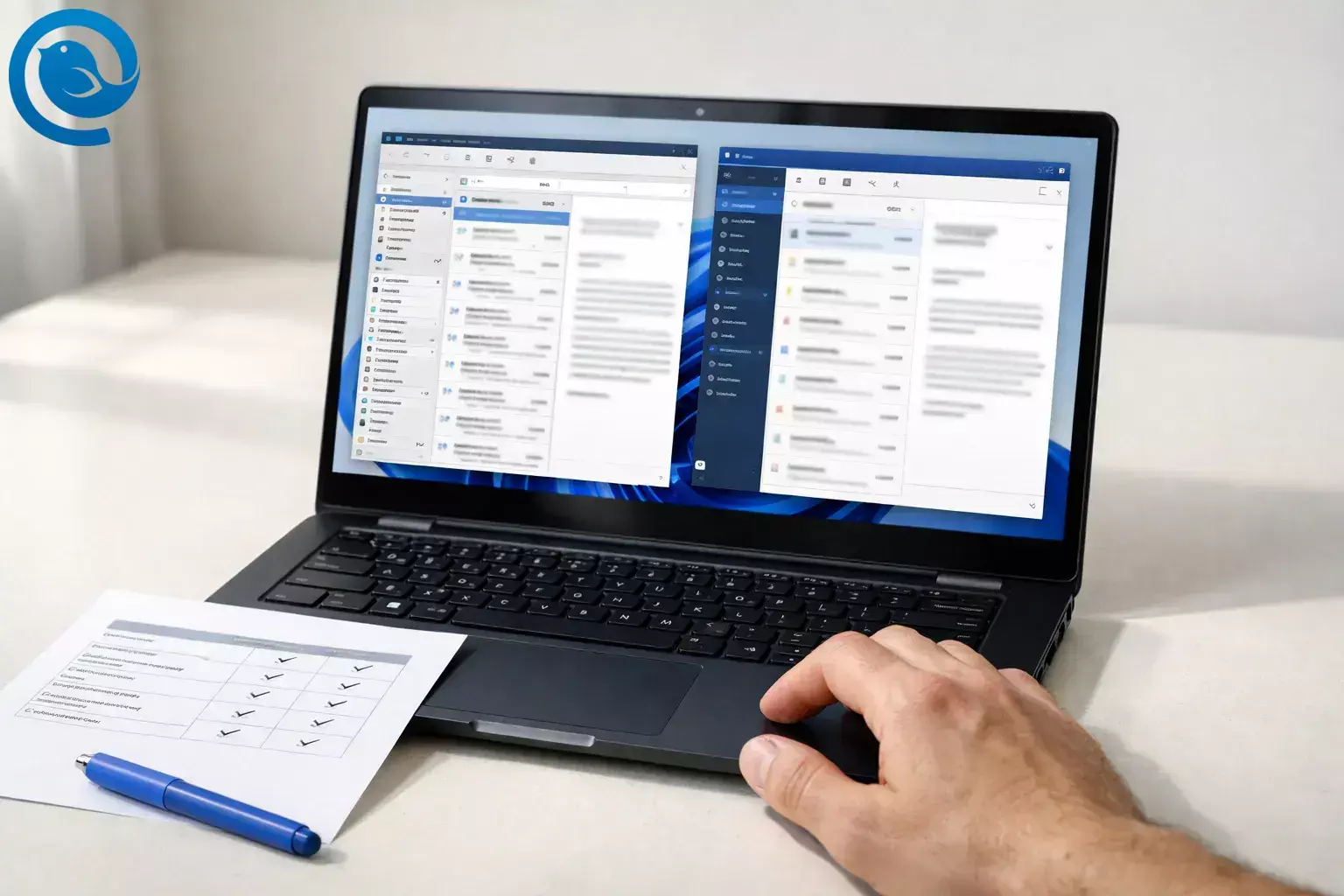
This guide focuses on what matters for Windows users: multi-account workflow, offline reality, integrations, pricing, and how painful it is to switch later. If you're evaluating more desktop options, see our guide to the best email clients for Windows.
What’s new (2026)
Google is removing Gmailify and POP-based “Check mail from other accounts” in Gmail on the web, with a staged shutdown through 2026.1
Key takeaways
- On Windows, you’re comparing two different things: Mailbird is a desktop email client, while Gmail is an email service you use mainly in a browser or mobile app.
- Choose Mailbird if you want a unified Windows workspace for multiple inboxes (Mailbird Free is limited to 1 account; Premium supports unlimited accounts).2
- Choose Gmail if you want a simple browser-first inbox and you don’t need Gmail on the web to collect mail from other providers.1
- Choose Gmail via Google Workspace if you need business email with centralized admin and security controls—then decide whether Mailbird should be your day-to-day Windows front end.710
- Offline reality: Gmail can work offline, but Google documents constraints (especially in Workspace-managed environments).5
- Modern sign-in: Google recommends “Sign in with Google” (OAuth) when connecting Gmail to third-party email clients, and notes you can connect a Gmail account to up to 15 email clients at a time.4
- Mailbird vs Gmail: Side-by-Side (Only the Differences That Matter)
- What each one is (and why that matters)
- Where Mailbird and Gmail are meaningfully different on Windows
- Costs, effort, and ownership trade-offs
- Risks and dealbreakers (when each is a bad choice)
- Switching path: change direction with minimal loss
- Decision tree (forces a choice)
- Frequently Asked Questions
- Sources
Tip: If you’re deciding fast, start with the side-by-side table, then jump to the “Risks and dealbreakers” section.
Mailbird vs Gmail: Side-by-Side (Only the Differences That Matter)
On Windows, this is mainly a choice between a desktop workspace (Mailbird) and a browser-first inbox (Gmail).
| Criteria | Mailbird | Gmail |
|---|---|---|
| What you’re choosing | A Windows desktop email client that connects to your existing accounts (for example, IMAP/POP3).9 | An email service + web/mobile app that hosts your mailbox (personal Gmail or Google Workspace).10 |
| Multi-provider “one inbox” on Windows | Built for multi-account + unified inbox; Free is limited to 1 account, while Premium supports unlimited accounts.2 | Gmail on the web is phasing out POP-based “Check mail from other accounts” and Gmailify; Google points users to forwarding or adding accounts in the Gmail mobile app via IMAP instead.1 |
| Offline on Windows | Desktop-client workflow; messages that have already synced remain available when you’re offline. | Offline mode exists, but comes with constraints (for Workspace, Google documents Chrome requirements, single-tab behavior, and local caching settings).5 |
| Integrations | App-style sidebar workflow (Mailbird highlights 30+ integrations plus custom apps/websites).9 | Deeply integrated with Google Workspace apps (Meet, Calendar, Chat, Tasks) inside the Gmail UI.10 |
| Typical cost model (US) | Free plan + paid Premium plans for multi-account and pro features.2 | Personal use without a Workspace subscription; paid upgrades for storage (Google One) or business features (Workspace).67 |
| Best fit | Windows users who live in email and want fewer tabs, one unified inbox, and a desktop-style workflow. | Anyone who wants web access everywhere and strong Google ecosystem integration. |
What each one is (and why that matters)
Mailbird
Mailbird is a desktop email client for Windows that connects your existing email accounts and organizes them in one unified workspace (Mailbird doesn’t provide email hosting).9
Key idea: you can use a Gmail address inside Mailbird.
Gmail
Gmail is Google’s email service that you use through a web app or mobile apps. If you're exploring desktop tools that work with Gmail accounts, you may also want to review how a Gmail email client works when managing multiple inboxes., with personal and Google Workspace options for individuals and businesses.10
Key idea: Gmail is both the mailbox provider and the interface.
Mailbird and Gmail aren’t strict substitutes—you can choose Gmail as your email provider and Mailbird as your Windows app, or stay fully in Gmail in your browser.910
Where Mailbird and Gmail are meaningfully different on Windows
1) Email provider (mailbox) vs inbox app (workflow)
Winner: Gmail if you need the mailbox + email address; Mailbird if you already have accounts and want a better Windows workflow. Mailbird is designed to connect to services like Gmail and other providers, while Gmail is the hosted inbox itself (see our full Mailbird vs Gmail comparison, especially relevant if you want Google Workspace as your business email provider).910
2) Multi-account on Windows: unified inbox vs “make Gmail the hub”
Winner: Mailbird for a true multi-provider Windows hub. Google is removing Gmailify and POP-based “Check mail from other accounts” on the Gmail website (with a staged shutdown through 2026). If your day involves multiple providers, adding those accounts directly to a desktop client is the cleaner Windows-friendly approach—just note Mailbird’s Free plan is limited to 1 account, and Premium supports unlimited accounts.12
3) Offline reality: desktop-first vs browser constraints
Winner: Mailbird if you frequently work offline (travel, spotty Wi‑Fi, field work). Gmail can work offline, but Google’s own documentation (for Workspace) notes practical constraints—Chrome requirements, Gmail needing to be open in a single tab, and local caching choices (including how many days to keep).5
4) Integrations and “tab overload”
Winner: Mailbird if your day spans many non-Google tools; Gmail if you’re all-in on Google Workspace. Mailbird positions itself as a unified workspace and highlights 30+ app integrations plus the ability to add custom apps/websites; Gmail shines when your communications and scheduling live inside Workspace apps embedded directly in the Gmail UI.910
5) Security, admin controls, and modern sign-in
Winner: Gmail (Google Workspace) for organizations that need centralized policies and security features. Google recommends “Sign in with Google” (OAuth) for connecting Gmail to third-party email clients, and it’s also promoting easier end-to-end encrypted email flows powered by client-side encryption for eligible Workspace plans.48
6) Lock-in and reversibility (how painful is “I chose wrong”?)
Winner: Mailbird for flexibility. Switching from Gmail-in-the-browser to Mailbird is mostly a UI/workflow change—your mailbox stays put. Switching away from Gmail as your email provider is a bigger project (changing addresses, migrating mail, updating sign-ins), especially if your team runs on Workspace. If you value reversibility, an email client keeps your options open.
Costs, effort, and ownership trade-offs
Pricing can change. The figures below reflect pricing shown on the official pricing pages on March 13, 2026. Promotions, taxes, and regional pricing can vary—verify before you buy.267
Mailbird: what you pay for (and what you “own”)
- Free: limited to 1 account—good for testing Mailbird as your daily Windows inbox.2
- Premium (Yearly): a subscription billed yearly.2
- Premium (Pay Once): a one-time license option exists, with optional add-ons (including “Lifetime Updates”).2
- Update rights matter: Mailbird’s “Lifetime Updates” is an optional add-on for Pay Once plans; Yearly subscriptions include updates by default.3
Mailbird plan limits, Pay Once details, and the Lifetime Updates model are described on Mailbird’s pricing page and support docs.23
Gmail: what you pay for (and where costs show up)
- Storage upgrades: Google One plans (US) list storage upgrades starting at 100 GB for $1.99/month (monthly billing view).6
- Business email: Google Workspace pricing lists Business Starter at $7/user/month (USD), with higher tiers above that (and time-limited promotions that may apply to new customers).7
Google’s pricing pages list the current storage and plan pricing for Google One and Google Workspace.67
Effort: setup time and ongoing friction
- Gmail-first: fastest start—open a browser, sign in, done.
- Mailbird-first: a one-time install + account setup, then you work from a single Windows app.
- Modern sign-in: Google recommends OAuth (“Sign in with Google”) for third-party mail apps and notes you can connect a Gmail account to up to 15 email clients at a time.4
Risks and dealbreakers (when each is a bad choice)
Mailbird is a bad choice if…
- You want a totally free solution for multiple inboxes (Mailbird’s Free plan is limited to 1 account).2
- Your organization’s policy forbids desktop email clients and requires web-only access.
- You’re buying Pay Once and assume updates are automatic—Mailbird treats “Lifetime Updates” as an add-on for Pay Once plans (Yearly subscriptions include updates by default).3
Gmail is a bad choice if…
- You need Gmail on the web to act as a long-term hub for multiple non-Gmail providers (Google is removing Gmailify and POP-based “Check mail from other accounts” on the Gmail website).1
- You need dependable offline work on Windows without browser constraints (offline mode has documented requirements and limitations, especially in Workspace-managed environments).5
- You want a single Windows workspace for many accounts without living in multiple browser sessions or switching contexts.
Switching path: change direction with minimal loss
If you started in Gmail (browser) and want Mailbird
- Keep your Gmail address. You’re not “moving providers”—you’re changing the Windows app you use.
- Install Mailbird on your Windows PC and add your Gmail/Workspace account.
- Use modern sign-in. If prompted, choose “Sign in with Google” (OAuth) rather than entering your Gmail password into an app.4
- If you previously pulled other inboxes into Gmail: add those accounts directly to Mailbird (or use forwarding, as Google suggests for Gmail on the web).1
If you started in Mailbird and want Gmail
- If your provider is Gmail/Workspace: simply sign in to Gmail on the web—your mail is still there.
- Remove the account from Mailbird if you don’t want the desktop client anymore.
- If you used Mailbird for multi-provider consolidation: plan how you’ll handle non-Gmail accounts going forward, since Gmail’s POP-based “Check mail from other accounts” is being removed (Google points to forwarding or the Gmail mobile app via IMAP).1
Practical tip: If your Gmail account is managed by Google Workspace, your admin can enforce sign-in and offline policies. If something doesn’t work the way you expect, check your Workspace settings first.5
Decision tree (forces a choice)
- If you need an email address and hosted mailbox (personal or business): pick Gmail.
- If you already have Gmail (or multiple providers) and want one Windows desktop hub: pick Mailbird.2
- If you have 2+ inboxes and refuse to pay for an email client: pick Gmail and accept separate logins/sessions.
- If offline work on Windows is a weekly reality: pick Mailbird.5
- If you run a team and need centralized admin/security controls (and possibly E2EE options): pick Gmail via Google Workspace—then decide whether your users should also use Mailbird for a desktop workflow.810
Try Mailbird as your Windows email client
If you're looking for a desktop email client designed for Windows productivity, Mailbird brings multiple inboxes into one unified workspace, integrates with popular apps, and supports Gmail and many other email providers.
You can explore features or download the app from the Mailbird homepage, or review current plans on the Mailbird pricing page.
Frequently Asked Questions
Can I use Mailbird with a Gmail address? — Yes. Mailbird is
Yes. Mailbird is an email client, so you can add your Gmail or Google Workspace inbox and manage it from the Mailbird desktop app.9
Is Gmail an email client? — Gmail is primarily
Gmail is primarily an email service and web/mobile app. You can also access Gmail from third-party email clients using standard protocols (IMAP/POP), but Gmail itself is the hosted inbox.10
Why can’t I “check mail from other accounts” in Gmail anymore? — Google is turning
Google is turning down POP-based “Check mail from other accounts” and Gmailify on the Gmail website, with a staged shutdown through 2026. Google points users to forwarding or using IMAP in the Gmail mobile app instead.1
Is Mailbird free? — Mailbird offers a
Mailbird offers a Free plan, but it’s limited to one email account. If you want a unified inbox across multiple accounts, you’ll typically need a paid plan.2
Do I need to enable IMAP in Gmail to use Mailbird? — If you’re connecting
If you’re connecting via IMAP, make sure IMAP access is enabled in your Gmail settings. Google also recommends using “Sign in with Google” (OAuth) when adding Gmail to an email client.4
Can Gmail work offline on Windows? — Yes, but offline
Yes, but offline access comes with constraints. In Workspace-managed environments, Google documents Chrome requirements, single-tab behavior, and local caching settings for Gmail offline.5
How many apps can connect to my Gmail account at the same time? — Google says you
Google says you can add a Gmail account to up to 15 email clients at a time per account.4
Does using Mailbird move my emails off Gmail? — No. An email
No. An email client connects to your provider; it doesn’t become your email host. Your messages remain in your email account (for example, Gmail or Workspace).9
- Gmail Help — Learn about upcoming changes to Gmailify & POP in Gmail
- Mailbird — Pricing and plans (https://www.getmailbird.com/pricing/)
- Mailbird Support — Why am I being charged for Lifetime Updates? (https://support.getmailbird.com/hc/en-us/articles/15354532511255-Why-am-I-being-charged-for-Lifetime-Updates)
- Gmail Help — Add Gmail to another email client
- Google Workspace Admin Help — Use Gmail offline with Google Workspace
- Google One — Plans & pricing
- Google Workspace — Pricing
- Google Workspace Blog — New in Gmail: Making end-to-end encrypted emails easy to use for all organizations (Apr 1, 2025)
- Mailbird — Product overview (desktop email client features and integrations) (https://www.getmailbird.com/)
- Google Workspace — Gmail product page


