How E-Receipt Scanning Apps Turn Your Inbox Into a Sellable Record of Your Purchases: What Mailbird Users Need to Know
Receipt scanning apps transform your email inbox into a monetizable database by extracting purchase data and selling it to investors and retailers. This guide reveals how inbox monetization works, the business models behind it, and how privacy-focused email clients help you maintain control over your personal transaction information.



If you've ever wondered why so many apps want access to your email inbox, you're not alone. Many users feel uneasy about granting email permissions to apps promising rewards, price tracking, or subscription management—and that instinct is absolutely justified. Behind the convenient interfaces of receipt scanning apps lies a sophisticated data extraction operation that systematically converts your personal purchase history into market intelligence products sold to investors, retailers, and competitors.
The transformation of email inboxes from private communication spaces into monetizable consumer databases represents one of the most significant privacy shifts in digital commerce. According to YipitData's analysis of alternative data markets, email receipt data has become one of the most valuable types of consumer information for long-term investors, providing granular insights into merchant performance, spending patterns, and competitive dynamics that aren't available through traditional financial disclosures.
This comprehensive guide examines how e-receipt scanning actually works, reveals the business models that drive inbox monetization, and explains how privacy-focused email clients like Mailbird can help you maintain control over your purchase data while still enjoying full email functionality.
Understanding the Inbox Monetization Ecosystem
Every time you complete an online purchase, your email inbox receives a digital receipt containing detailed transaction information: merchant names, product categories, prices, timestamps, and order identifiers. These seemingly innocuous confirmations have become the foundation of a multi-billion dollar alternative data industry that most consumers don't even know exists.
From Personal Communications to Purchase Panels
The rise of e-commerce has inadvertently created comprehensive digital records of consumer behavior stored in email accounts. When NielsenIQ acquired Rakuten Intelligence, the measurement giant emphasized that it was gaining access to "the largest e-commerce purchase panel in the United States"—a panel built almost entirely from email receipt data extracted from users' inboxes.
This transformation didn't happen by accident. Specialized analytics firms recognized that email receipts offer unique advantages for tracking consumer behavior at scale. Unlike survey data or loyalty programs, email receipts are standardized, automatically generated, and strongly tied to actual transactions. They provide a consistent, reliable signal that can be parsed programmatically and aggregated across millions of consumers.
Edison Trends positions its email receipt dataset as sourced entirely from a proprietary email application, demonstrating how consumer-facing tools can double as data collection mechanisms for market intelligence services. The company markets these insights to investors and businesses seeking competitive advantages through early visibility into sales trends and market shifts.
The Hidden Business Models Behind "Free" Apps
Many users first encounter inbox monetization through apps that appear to offer straightforward utility or rewards. These services typically fall into several categories, each with its own approach to extracting value from your purchase data:
Email Management Tools: The most notorious example remains Unroll.me, which marketed itself as a simple email organization service. Business Insider's investigation revealed that Unroll.me's parent company was systematically extracting e-receipt data from users' inboxes and selling anonymized information to corporate clients—including selling Lyft ride receipts to competitor Uber.
Rewards Programs: Amazon Shopper Panel takes a more transparent approach, explicitly offering users monthly rewards in exchange for uploading receipts or forwarding email confirmations. The program description states that this data helps Amazon "improve the selection of products and services, pricing, and advertising effectiveness"—a clear acknowledgment that purchase information feeds directly into Amazon's business intelligence systems.
Price Protection Services: When Capital One acquired Paribus, it gained a service that scans users' email inboxes for purchase receipts and monitors prices to claim automatic refunds. While users benefit from recovered savings, the service requires continuous access to transactional emails and generates detailed records of shopping behavior.
Fetch Rewards' eReceipts program similarly promises reward points for linking email and retailer accounts, enabling automatic receipt detection and processing. The company's privacy policy acknowledges that digital receipt participants may have their account credentials and personal information collected from linked accounts—extending data access well beyond just receipts.
How E-Receipt Scanning Actually Works
Understanding the technical process behind inbox monetization helps clarify exactly what you're authorizing when you grant an app access to your email account. The transformation from inbox to sellable database involves several sophisticated steps that most users never see.
The Permission Gateway
Google's official documentation on account access explains that when users authorize third-party apps, they must explicitly grant specific permissions that define the scope of data access. For e-receipt scanning services, this typically means read-only access to email messages, though implementations vary in granularity.
The authorization process uses secure OAuth flows rather than password sharing, which Google strongly warns against because sharing passwords would give apps complete account access and compromise security. However, even properly scoped read-only access to email can expose far more than just purchase receipts, depending on how broadly the app defines its scanning parameters.
ExpenseBot's Gmail Receipt Scanner demonstrates this model clearly: it connects to Gmail, automatically reads receipts, extracts transaction details like amounts and vendors, and syncs the structured data to Google Sheets. To perform these functions, ExpenseBot must be authorized to access messages matching specific criteria—typically sender domains or subject patterns associated with commercial emails.
Parsing and Structuring Receipt Content
Once an app gains inbox access, it must identify which messages constitute receipts and convert their semi-structured content into standardized database records suitable for analytics and resale. This involves sophisticated pattern recognition and natural language processing because receipts from different merchants follow varying formats.
The parsing process typically extracts several key data points from each receipt:
- Transaction timestamp: Date and time of purchase
- Merchant identification: Store or platform name, often normalized to standard categories
- Order value: Total amount, taxes, and itemized costs
- Product details: Item names, quantities, and categories
- Customer identifiers: Order numbers, account references, and shipping information
In the Unroll.me controversy, CBS News reported that Slice Intelligence told them it extracted commercial e-receipts from users' inboxes and emphasized that it focused on HTML headers and promotional emails rather than personal communications. However, this distinction offered little comfort to users who felt their ride-hailing receipts—which could reveal travel patterns and location history—had been exploited without their full understanding.
Anonymization and Aggregation: Real Protection or Privacy Theater?
Most e-receipt scanning services emphasize that they anonymize and aggregate data before selling it, positioning these safeguards as sufficient privacy protections. However, privacy experts increasingly question whether anonymization fully addresses the risks associated with inbox-derived data.
Verasafe's analysis of privacy obligations under GDPR underscores that even pseudonymized data can still be considered personal data if it can be attributed to individuals with additional information. This is especially relevant for inbox-derived receipt data, which may contain unique combinations of merchants, timestamps, and purchase patterns that could potentially be linked back to individuals when combined with other datasets.
The emphasis on anonymization can create what might be called the "illusion of privacy"—users assume that if their names aren't attached to the data, it's harmless, even though it still contributes to detailed maps of consumer behavior and can affect markets, prices, and services in ways that ultimately impact them. When Unroll.me users learned their Lyft receipts had been used to provide Uber with competitive intelligence about Lyft's business health, many expressed feeling betrayed regardless of whether their individual identities were attached to the data.
Privacy Violations, Regulatory Actions, and User Rights
The growing awareness of inbox monetization has triggered both public backlash and regulatory scrutiny, leading to enforcement actions that clarify how companies must handle email-derived data.
The Unroll.me Settlement and Its Implications
The Federal Trade Commission's settlement with Unroll.me's parent company in 2019 focused on allegations that the service had deceived consumers about how their emails would be used. The settlement didn't prohibit the sale of anonymized purchase data itself, but it required clearer disclosures and consent mechanisms, demonstrating that regulators are particularly concerned with transparency and fairness in how inbox access is presented to users.
The enforcement action established several important principles that apply broadly to e-receipt scanning services:
- Transparency requirements: Companies must clearly disclose when email access will be used for purposes beyond the primary service functionality
- Consent standards: Users must be given meaningful opportunities to understand and agree to data monetization practices
- Scope limitations: Services should collect only the data necessary for stated purposes, not broadly scan all inbox contents
GDPR and Cross-Border Data Protection
Verasafe's guidance on privacy obligations emphasizes that under GDPR, all processing of personal data—including by data brokers and organizations that purchase brokered data—must comply with strict requirements. This means that not only the initial collectors of e-receipt data, but also downstream purchasers and users must consider their obligations regarding transparency, legal basis, data subject rights, and data minimization.
For users in the European Union, GDPR provides several important protections:
- Right to access: You can request information about what personal data is being processed and how
- Right to erasure: You can demand deletion of your data under certain circumstances
- Right to data portability: You can obtain your data in a structured, commonly used format
- Right to object: You can oppose processing based on legitimate interests or direct marketing
Managing Your Email Account Permissions
Google's guidance on managing app access encourages users to regularly review which third-party services have access to their accounts and to revoke permissions for apps they no longer use or trust. The platform provides tools to see exactly what data each connected app can access and to set time limits on permissions.
For users concerned about inbox monetization, proactive permission management is essential:
- Regularly audit connected apps through your email provider's security settings
- Revoke access for services you no longer actively use
- Read privacy policies carefully before authorizing new apps
- Consider using separate email addresses for rewards programs and price tracking services
- Look for services that explicitly commit not to sell or share your data
How Mailbird's Architecture Protects Your Inbox Privacy
Understanding how e-receipt scanning apps exploit inbox access makes it clear why the architectural choices of your email client matter. Mailbird's design represents a fundamentally different approach to email handling that can significantly reduce your exposure to inbox monetization.
Local Storage vs. Cloud-Based Email Processing
Mailbird's local email storage model stores all your emails directly on your device rather than maintaining copies on company servers. This architectural choice has profound implications for privacy and data protection.
Unlike cloud-based email services or apps that process messages on their servers, Mailbird's local storage means:
- No centralized repository: Your emails aren't aggregated with millions of other users' messages in databases that could be attractive targets for data brokers
- Reduced attack surface: There's no central Mailbird server storing inbox contents that could be breached or subpoenaed
- User control: Your email data remains physically on devices you control, not in cloud infrastructure managed by third parties
- Minimal processing: Mailbird doesn't need to scan or analyze email contents on its servers because it doesn't store them there
Mailbird's privacy-friendly design features extend beyond just storage architecture. The client emphasizes data minimization throughout its operations, collecting only the usage statistics and technical information necessary to improve software performance rather than building detailed profiles of user communications or purchase behavior.
GDPR Compliance Through Privacy-by-Design
Mailbird's privacy policy clearly outlines what limited data the company collects, focusing on software usage metrics and computer specifications rather than email content. This approach aligns with GDPR's privacy-by-design principles, which encourage organizations to minimize data collection and build privacy protections directly into their systems rather than adding them as afterthoughts.
The contrast with e-receipt scanning apps is striking. While services like Fetch, Paribus, and Amazon Shopper Panel require extensive access to email contents and explicitly describe collecting purchase information for analytics and business intelligence, Mailbird's business model doesn't depend on monetizing your inbox. The company earns revenue through software licenses rather than data sales, creating a fundamentally different set of incentives around user privacy.
Maintaining Control While Using Third-Party Services
It's important to understand that using Mailbird doesn't automatically prevent third-party apps from accessing your email account. Because Mailbird connects to email providers like Gmail, Outlook, and others using standard protocols, you can still authorize apps to access your messages through your provider's API—regardless of which email client you use to view those messages.
However, Mailbird's architecture offers several practical advantages for privacy-conscious users:
- Compartmentalization: You can easily manage multiple email accounts in Mailbird, using separate addresses for rewards programs while keeping your primary inbox free from scanning apps
- Visibility: Mailbird's focus on local storage and minimal data collection makes it easier to understand exactly where your email data is stored and who has access to it
- No additional exposure: Unlike email apps that themselves participate in data monetization, Mailbird doesn't add another layer of potential data extraction to your email workflow
For users who choose to participate in rewards programs or use price tracking services, Mailbird's multi-account support enables a strategic approach: create a dedicated email address specifically for these services, link it through Mailbird, and keep your primary personal and business communications separate from inbox monetization ecosystems.
Practical Strategies for Protecting Your Purchase Data
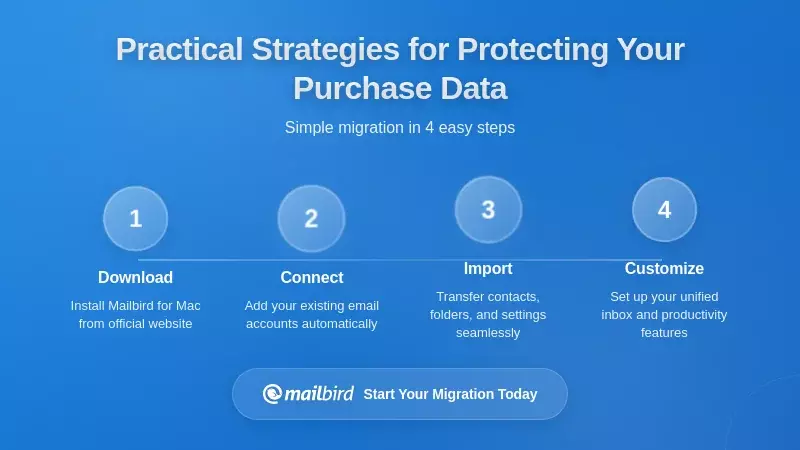
Understanding the risks of inbox monetization is only the first step. Implementing practical strategies to protect your purchase data while still benefiting from legitimate email services requires a thoughtful approach.
Evaluating E-Receipt Scanning Apps Before Granting Access
Before authorizing any app to access your email account, conduct a thorough evaluation of its data practices:
Read the privacy policy carefully: Look specifically for sections describing how the company uses email data, whether it shares or sells information to third parties, and what anonymization or aggregation measures it employs. Fetch's privacy policy, for instance, explicitly states that digital receipt program participants may have their account credentials and personal information collected from linked accounts.
Understand the business model: Ask yourself how the service makes money. If an app is free and offers rewards without clear revenue sources like subscriptions or transaction fees, it's likely monetizing your data. Services that are transparent about data use—like Amazon Shopper Panel, which explicitly describes using receipt information for business intelligence—at least allow you to make an informed decision.
Check the scope of requested permissions: Review exactly what access the app is requesting. Does it need read-only access to all email messages, or can it be limited to specific senders or date ranges? Broader permissions create more risk that sensitive communications beyond receipts could be exposed.
Research the company's track record: Look for news coverage, regulatory actions, or user complaints about the service's data practices. The Unroll.me controversy serves as a reminder that apps can operate for years before their data monetization practices become widely known.
Creating Email Compartmentalization Strategies
One of the most effective ways to limit exposure to inbox monetization is to use separate email addresses for different purposes:
Primary personal/business inbox: Reserve your main email address for important communications, financial accounts, and personal correspondence. Never grant e-receipt scanning apps access to this account.
Shopping and rewards inbox: Create a dedicated email address specifically for online purchases, loyalty programs, and rewards apps. Use this address when signing up for e-receipt scanning services, accepting that this inbox's contents may be analyzed and monetized.
Subscription and newsletter inbox: Maintain a separate address for marketing emails and subscriptions, reducing clutter in your primary inbox and limiting what commercial senders can learn about your communication patterns.
Mailbird's unified inbox and multi-account management make it easy to monitor all these addresses from a single interface while maintaining clear separation of their contents and purposes.
Implementing Technical Controls
Legal guidance on data access agreements emphasizes the importance of technical controls alongside policy measures. While this guidance typically addresses organizations protecting their data, similar principles apply to individuals:
- Use email filtering: Configure rules to automatically archive or delete commercial emails after a certain period, reducing the historical data available to scanning apps
- Limit retention: Regularly clean out old receipts and transactional emails you no longer need
- Review permissions quarterly: Set a calendar reminder to audit which apps have access to your email accounts and revoke unnecessary permissions
- Enable two-factor authentication: Add an extra layer of security to prevent unauthorized access to your email accounts
Alternative Approaches to Receipt Management
If you need receipt organization and expense tracking but want to avoid granting broad inbox access, consider alternative approaches:
Manual forwarding: Some services allow you to forward individual receipts to a designated address rather than granting full inbox access. While less convenient, this gives you explicit control over exactly which transactions are shared.
Local receipt management: Use desktop software or mobile apps that store receipts locally on your devices rather than uploading them to cloud services. Tools like ExpenseBot can sync to your own Google Sheets, giving you more control over where data is stored.
Screenshot and file management: For important receipts, take screenshots or save PDFs and organize them in your own file system rather than relying on apps that analyze your entire inbox.
Accounting software integration: Professional accounting tools often include receipt capture features that don't require full email access, instead using dedicated mobile apps or email forwarding to specific addresses.
The Future of Inbox Monetization and Consumer Protection
Understanding current trends in inbox monetization helps anticipate how these practices may evolve and what additional protections users may need.
Consolidation in the Alternative Data Market
The acquisition of Rakuten Intelligence by NielsenIQ exemplifies a broader trend toward consolidation in the alternative data market. As large measurement firms and financial institutions acquire e-receipt scanning services, inbox-derived purchase data becomes integrated into mainstream analytics products used by retailers, consumer goods companies, and investors.
This consolidation creates both opportunities and risks. On one hand, larger companies may implement more robust privacy safeguards and comply more rigorously with regulations like GDPR. On the other hand, concentration of inbox data in fewer hands amplifies the potential impact of breaches or misuse, and reduces competitive pressure to offer privacy-friendly alternatives.
YipitData's analysis of email receipt data for investors shows how sophisticated these applications have become. Purchase panels now support cohort analysis, merchant performance tracking, market share estimation, and predictive modeling—all built on the foundation of inbox-derived transaction records. As these capabilities advance, the commercial value of email access will likely increase, creating stronger incentives for companies to find new ways to access inbox data.
Regulatory Evolution and Enhanced Consumer Rights
The regulatory landscape around inbox monetization continues to evolve. The FTC's action against Unroll.me established that transparency and consent are non-negotiable requirements, but enforcement remains inconsistent. Future regulatory developments may include:
- Stricter consent standards: Requirements for explicit, granular consent before apps can access email accounts for data monetization purposes
- Data broker registries: Public databases of companies engaged in personal data brokerage, including those using inbox-derived purchase records
- Enhanced deletion rights: Stronger requirements for companies to delete email-derived data upon user request, including data already sold to third parties
- Algorithmic transparency: Obligations to disclose how purchase data is used in pricing, targeting, or other automated decisions that affect consumers
Privacy consultancies like Verasafe note that organizations working with data brokers must increasingly consider not just whether data is anonymized, but whether their entire data supply chain respects consumer rights and regulatory requirements. This creates pressure throughout the ecosystem to implement better safeguards.
Privacy-Enhancing Technologies and User Empowerment
As awareness of inbox monetization grows, we're likely to see increased adoption of privacy-enhancing technologies and services:
Privacy-focused email clients: Services like Mailbird that emphasize local storage and minimal data collection may gain market share as privacy-conscious users seek alternatives to cloud-based platforms that participate in data monetization.
Encrypted email services: End-to-end encrypted email providers make it technically difficult for third parties to scan message contents, though they may limit integration with certain convenience features.
Differential privacy techniques: Advanced anonymization methods that add mathematical noise to datasets, making it provably difficult to identify individuals while still enabling aggregate analysis.
User-controlled data vaults: Emerging technologies that allow individuals to store their own data and selectively share it with services on their own terms, rather than granting broad access to entire inboxes.
The key to navigating this evolving landscape is staying informed about how your email data can be used and choosing tools and services that align with your privacy preferences. Mailbird's commitment to local storage and transparent data practices positions it as a valuable option for users who want to maintain control over their inbox contents while still enjoying modern email functionality.
Frequently Asked Questions
Can apps really sell my email data even if they say it's "anonymized"?
Yes, apps can and do sell anonymized purchase data extracted from your inbox. The Unroll.me case revealed that the service sold anonymized Lyft receipt data to Uber for competitive intelligence. While true anonymization removes direct identifiers like names, research shows that unique combinations of purchase patterns, timestamps, and merchants can potentially be re-identified when combined with other datasets. Under GDPR, even pseudonymized data may still be considered personal data if it can be attributed to individuals with additional information, meaning anonymization doesn't eliminate all privacy concerns.
How does Mailbird's local storage protect my purchase data compared to other email clients?
Mailbird stores all emails locally on your device rather than maintaining copies on company servers, which fundamentally reduces exposure to inbox monetization. Unlike cloud-based email services that aggregate millions of users' messages in centralized databases—making them attractive targets for data brokers—Mailbird's architecture means the company doesn't have access to your email contents to scan, analyze, or sell. However, it's important to understand that Mailbird doesn't prevent third-party apps from accessing your email account through your provider's API if you explicitly authorize them. The key difference is that Mailbird itself doesn't participate in inbox monetization, and its multi-account support makes it easy to compartmentalize email addresses used for rewards programs from your primary inbox.
Are rewards apps like Amazon Shopper Panel and Fetch worth the privacy trade-off?
This depends entirely on your personal privacy priorities and how you value the rewards offered. Amazon Shopper Panel offers up to $10 monthly for uploading receipts, while Fetch provides gift card rewards for linking email accounts and submitting receipts. The research shows these programs explicitly use your purchase data for business intelligence, market research, and advertising optimization. If you choose to participate, consider using a dedicated email address specifically for these programs rather than linking your primary inbox, and carefully review each service's privacy policy to understand exactly how your data will be used and whether it's shared with third parties.
What happened with Unroll.me and why should I care?
The Unroll.me controversy revealed that a service marketed as helping users manage email subscriptions was simultaneously extracting e-receipt data from their inboxes and selling it to corporate clients. Most notably, the company collected Lyft ride receipts and sold anonymized data to competitor Uber, which used it to gauge Lyft's business health. This triggered public outrage because users felt deceived—they had authorized inbox access for email management, not competitive intelligence gathering. The FTC settlement in 2019 required clearer disclosures but didn't prohibit the practice itself. The case demonstrates why you should carefully evaluate any app requesting inbox access and understand that "free" services often monetize your data as their business model.
How can I check which apps currently have access to my email account?
Google provides tools to review and manage third-party app access through your account security settings. Navigate to your Google Account, select "Security," then "Third-party apps with account access" to see which services can read your emails. You can revoke access for any app you no longer use or trust. For other email providers like Outlook or Yahoo, similar permission management tools are available in account settings. The research findings emphasize that you should audit these permissions quarterly, removing access for apps you don't actively use, and carefully reviewing what data each connected service can access. If you discover apps with permissions you don't remember granting, revoke them immediately and consider changing your password as a precaution.
Is my purchase data valuable enough that companies would actually pay for it?
Yes, absolutely. YipitData identifies email receipt data as one of the most valuable types of alternative data for long-term investors, and NielsenIQ's acquisition of Rakuten Intelligence specifically highlighted the value of "the largest e-commerce purchase panel in the United States" built from inbox-derived data. Your individual purchase history might seem mundane, but when aggregated with millions of other consumers' data, it provides powerful insights into market trends, competitive dynamics, merchant performance, and consumer behavior that investors and businesses are willing to pay significant sums to access. This is why so many "free" apps are eager to gain access to your inbox—your purchase data is genuinely valuable to them.
Can I use price protection services like Paribus without compromising my entire inbox?
Price protection services like Paribus require continuous access to your email inbox to scan for purchase receipts and monitor price changes. The most effective way to limit exposure is to create a dedicated email address specifically for online shopping, use that address for all e-commerce purchases, and only grant Paribus access to that account. This compartmentalization strategy—which Mailbird's multi-account support makes convenient—ensures your personal correspondence, financial communications, and business emails remain separate from the inbox being monitored for price tracking. You'll still benefit from automatic refunds while limiting what portion of your email communications is accessible to the service.
What are my rights under GDPR if I'm concerned about how my inbox data is being used?
Under GDPR, you have several important rights regarding personal data derived from your inbox, including purchase records. You can request access to information about what data is being processed and how (right to access), demand deletion of your data under certain circumstances (right to erasure), obtain your data in a structured format (right to data portability), and object to processing based on legitimate interests or direct marketing (right to object). These rights apply not just to the apps that directly access your inbox, but also to data brokers and companies that purchase inbox-derived purchase data. If you're an EU resident and concerned about how your email data is being used, you can exercise these rights by contacting the relevant companies' data protection officers and, if unsatisfied with their response, filing complaints with your national data protection authority.


